
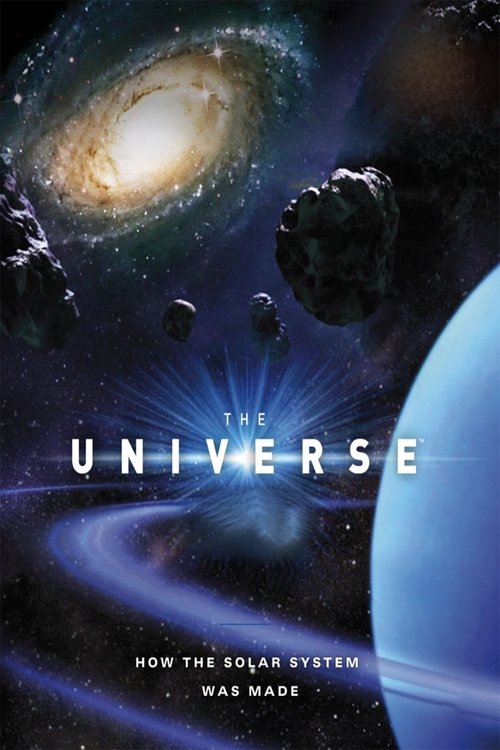
The Universe: How the Solar System was Made
2011 · 45 MIN · IMDB 7.2 · 71 VOTES
Overview
At 4.6 billion years old, the Solar System is our solid, secure home in the Universe. But how did it come to be? In this episode we trace the system's birth from a thin cloud of dust and gas. Shocked by a nearby supernova, the pull of gravity and natural rotation spun it into a flat disc from which the Sun and planets coalesced. It all happened in the space of 700 million years, during which the planets jockeyed for position, dodging the brutal bombardment of deadly asteroids and setting into the neat, stable system that we now realize might be a rarity in the universe.
Dialogue Timeline — 667 lines
A SAMPLE ACROSS THE RUNTIME — EVERY LINE IS SEARCHABLE
00:00:00 In the beginning, there was darkness, and then-- Bang! Giving birth to
00:01:57 it can send a shockwave through this molecular cloud...
00:03:44 Solar System becomes a virtual theme park of chaotic
00:05:30 As the pre-solar cloud collapses
00:07:05 It's not circular.
00:08:32 We happen to live on a planet
00:10:20 close to it.
00:11:41 And in the Solar System, without collisions, there would be no
00:14:03 in the region of the Solar System at that point.
00:16:07 abundant, the teeming mob of protoplanets collide and fuse in
00:18:39 a disc of gas and dust around a star, and the inner parts
00:20:35 We can see them at a variety of angles, tilts relative to our line of sight.
00:22:36 It has reached the critical threshold of heat and pressure
00:24:41 Jupiter was passing through what's now the asteroid belt, pumping up the
00:26:08 Perfect.
00:27:39 Great.
00:29:26 each other around the Sun in a dangerous duet.
00:31:37 In the early Solar System, the three outermost
00:33:33 It's a gravitational boost that large planets can give small objects.
00:35:36 basis, creating an immense gravity pump.
00:37:44 these comets fell into the inner Solar System
00:39:55 blasting out holes no wider than a human hair.
00:41:58 systems, whose formation sheds essential light on our own.
04:56:08 billion years old, the oldest
Cast & Characters
Erik Thompson
Narrator
Alex Filippenko
Self - Univ. of California, Berkeley
Michael Mischna
Self - NASA
Michael Mischna
JPL
Edward Young
Self - Univ. of California, Los Angeles
Clifford V. Johnson
Self - Univ. of Southern California
Laura Danly
Self - Griffith Observatory
Mike Brown
Self - Caltech
Charles Beichman
Self - NASA Exoplanet Science Institute
Ryan Johnson
Self - Special effects artist
Ryan C. Johnson
Special Effects artist
Dialogue Record
Lines indexed667
Dialogue density14.8 lines / min
First line00:00:00
Final line04:56:08
Production Record
LanguageEnglish
IMDb votes71