
McLuhan's Wake
2002 · 90 MIN · IMDB 6.4 · 99 VOTES · DIR. David Sobelman, Kevin McMahon
Overview
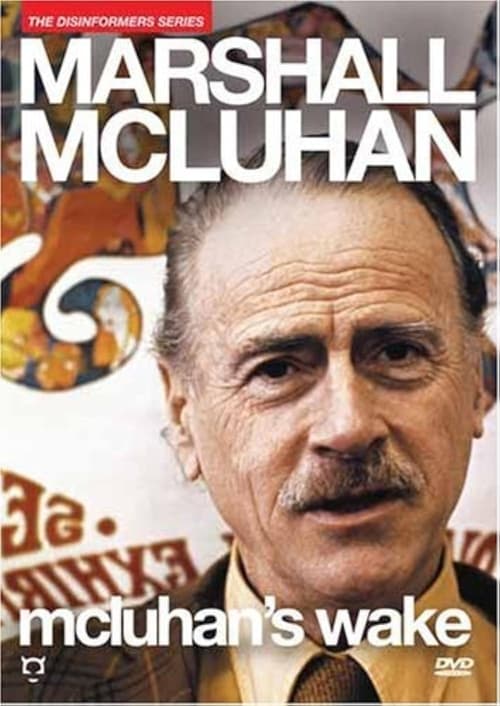
A fascinating clash of philosophy, classical studies and Pop Culture, this film capsulizes a number of "Media Prophet" Marshall McLuhan's conclusions about media.
Dialogue Timeline — 272 lines
A SAMPLE ACROSS THE RUNTIME — EVERY LINE IS SEARCHABLE
00:00:21 WOMAN IN AD: Now! The dream cars of tomorrow!
00:07:48 ROBERT LOGAN: No field intimidated him. Everything he read, he sort of wove it into a picture...
00:11:13 HUNTER: 1 Were in a good position, the winds coming at us.
00:14:09 TEACHER: The letter V
00:15:00 LAURIE ANDERSON: C is for caterpillar. Cuh ah ta eh rrr pillar
00:20:21 SALESMAN: All our Jaguars come with tradition behind them.
00:23:06 PHILLIP MARCHAND: McLuhan was always kind of a serious young kid. He was encouraged to and eagerly memorized long passages from poets. I think for the young Marshall, literature was the higher plane.
00:27:07 PHILLIP MARCHAND: Thomas Aquinas says trust the authority of the senses. And then theres the almost medieval notion of the five senses as working together in a kind of workshop, to re create reality in the mind of the individual. So McLuhan always believed that if you really listened, and saw and felt, you could perceive correctly.
00:33:05 MCLUHAN: Id rather be in any period at all, as long as people are going to leave it alone for a while. Just let go! Just leave it. I am resolutely opposed to all innovation, all change, but I am determined to understand whats happening. Because I dont chose to just sit and let the juggernaut roll over me. Now, this uh, many people seem to think that if you talk about something recent, then youre in favour of it. Well, the exact opposite is true in my case, anything I talk about is almost certain to be something that I am resolutely against. And it seems to me that the best way of opposing it is to understand it and then you know where to turn off the button.
00:38:04 LAURIE ANDERSON: You reshape the space all around you. New figures appear, new connections are made, a new world arises out of the old.
00:42:32 MCLUHAN: Now, you see, we have a media that stress all the senses and we have no education to cope with the media at all.
00:47:09 ROY THOMPSON: The dominant medium of communication of any age alters the way people think, feel, act, and react. Television is thus returning the viewers to the picture thinking of primitive men. Of course, I think this is all pie in the sky myself.
00:49:22 ANNOUNCER 3:Tonight from London, the Marshall McLuhan Golden Probe show!
00:53:38 ROBERT LOGAN: The left side of the brain was linear and sequential. And the right side of the brain was holistic.
00:58:22 MCLUHAN: The happy tendency of technological innovation tends to tidy up the old culture, whatever it happens to be, into a work of art.
01:02:41 LAURIE ANDERSON: Electric media retrieve the old dark age of goddesses and monsters
01:06:27 FRANK ZINGRONE: He was on the most popular show on television at that time which was the "Laugh In". And they had, this nerdish character, Henry Gibson, would come out and he would say "Marshall McLuhan, what are you doin?" So, like, 40 million people were suddenly aware of his name.
01:09:07 wrong, or that McLuhan should not be taken seriously because he has a hidden agenda, whether as a Roman Catholic, or as a conservative in terms of his values. The chief charge against McLuhan was simply to say "Hes a technological determinist! What he says is the machines make the rules" .
01:10:38 HUGH DOWNS: And think about it for hours afterwards.
01:14:45 ERIC MCLUHAN: We were looking for universal laws, and we found only four that everything does. These four questions ask you to look at what are the ripple effects. What other areas are effected? Irrespective of the content. And you begin to realize, media are like languages. That is, they are far more powerful than anything they are used to say. The idea that media and innovations and so on are human utterances with the properties of languages this is new. It is also extremely ancient. The grammarian used language as a metaphor, as a way of understanding the universe. He read the heavens as a text, he read the Earth as a text. He tried to discover laws. And our laws of media are a new foray into that very ancient way of understanding.
01:20:28 REPORTER: Can we get your reaction to whats happened? The tragedy next door?
01:23:38 CORINNE MCLUHAN: It seems rather wicked to me, thinking back about Marshalls stroke, that a man who lived by his brains and his intellectual life should be so stricken. You know, its pretty cruel to be in Marshalls state. Not being about to speak or read or write. And he was in that state for 15 months.
01:28:06 ERIC MCLUHAN: We have now, at our fingertips, the beginnings of a science of media ecology. But it means that we have to take charge of these things, to decide not to do things as well as to just to go ahead and do them. However, this I think is, at least, part of the legacy of Marshall McLuhan. He left us with the means of control. Not just the means of understanding.
Cast & Characters
Dialogue Record
Lines indexed272
Dialogue density3.0 lines / min
First line00:00:21
Final line01:28:06
Production Record
DirectorDavid Sobelman, Kevin McMahon
LanguageEnglish
IMDb votes99